
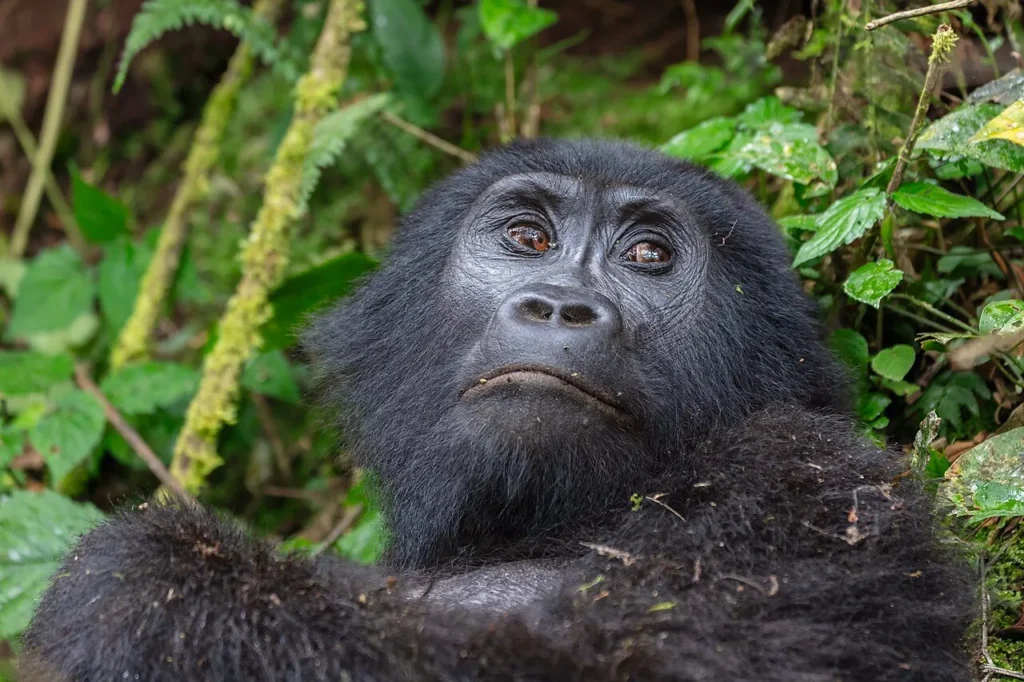
Mountain Gorilla Photography Guide: Camera Tips, Lenses & Safari Planning
A practical guide for photographing mountain gorillas in Uganda and Rwanda, including camera settings, lens choices, low-light techniques, composition, equipment protection, ethical rules and how to plan a photography-focused safari.
Hero photo: Diego Delso, CC BY-SA 4.0, via Wikimedia Commons.
A mountain gorilla photography guide should begin with one important reality: photographing gorillas is not like photographing animals on an open savannah. The forest is darker, the subjects are often partly hidden by vegetation, movement can be sudden, and your viewing time is controlled by park rules. That combination makes preparation much more important than carrying the most expensive camera.
The best photographers arrive with simple, tested equipment and a clear plan. They know how to change shutter speed quickly, they understand how their autofocus behaves in foliage, and they have already decided which lens they can comfortably carry during a long trek.
This post focuses on the technical and practical side of gorilla photography. If you are looking for complete safari options, repeated trek planning and private itinerary ideas, visit Tavira Africa Safaris’ main Mountain Gorilla Photography Safaris page.
The Three Biggest Gorilla Photography Challenges
Dark Forest Conditions
Dense canopy means shutter speed can drop quickly, especially when a gorilla moves into deep shade.
Leaves Between You & the Subject
Branches can confuse autofocus and make clean framing difficult.
Limited Viewing Window
Standard trekking gives approximately one hour with the habituated family after it is located, so camera preparation matters.
Best Camera Settings for Mountain Gorilla Photography
There is no universal setting that works for every gorilla. A resting silverback in open light and a moving juvenile under dense canopy require completely different exposure decisions. The goal is to create a flexible starting point you can adjust quickly.
| Setting | Useful Starting Point | Why |
|---|---|---|
| Shutter speed | 1/250s or faster for resting subjects | Helps avoid blur from small subject and camera movement. |
| Fast movement | 1/500s or faster when light allows | Useful for juveniles and quick behavioural moments. |
| Aperture | Wide aperture where practical | Lets in more light and can simplify a busy background. |
| ISO | Raise as necessary | Protects shutter speed in low light. |
| Autofocus | Continuous AF / subject tracking | Helps when the gorilla changes position. |
These are photographic suggestions rather than park rules. Adjust them to your camera, lens and available light.
Shutter Speed Matters More Than Perfectly Clean ISO
Many photographers arrive in the forest trying to keep ISO low because they want the cleanest possible file. That can be a mistake. If keeping ISO low forces the shutter speed down too far, small movements in the gorilla’s face or hands can ruin the frame.
A sharp image at ISO 3200 may be far more useful than a soft image at ISO 800. Modern noise reduction software is powerful, but no software can fully recover motion detail that was never captured.
For unpredictable forest wildlife, prioritise the minimum shutter speed you need and allow ISO to move as conditions change.

Photo: Giles Laurent, CC BY-SA 4.0, via Wikimedia Commons.
Focus on the Nearest Eye
For close gorilla portraits, the eyes are usually the most important point of focus. If the nearest eye is sharp, the image often feels convincing even when the depth of field is shallow.
Dense forest can confuse autofocus. Animal-eye detection may work brilliantly one moment and lock onto a leaf the next. Test your camera before travel and know how to switch quickly to a smaller focus area.
Do not spend the encounter fighting with menus. Configure autofocus behaviour, back-button focus if you use it, and custom controls before trekking day.
Best Lenses for Gorilla Photography
The best lens is usually the one you can carry comfortably and use quickly. Extreme reach is less important than flexibility and low-light performance.
Best All-Round Choice
Useful for portraits, behaviour and changing distances. A fast f/2.8 version is particularly helpful in low light.
Environmental Frames
Useful when you want to include more forest context rather than filling the frame with the gorilla.
Less Gear, More Speed
One versatile zoom can be better than changing lenses in rain, mud and thick vegetation.

Photo: Charles J. Sharp, CC BY-SA 4.0, via Wikimedia Commons.
Photograph Relationships, Not Just Individuals
A mother and infant, two juveniles playing or a silverback watching the group often tells a stronger story than a single portrait. Look for relationships between subjects.
When behaviour begins, avoid zooming too tightly. Leaving space around the animals gives you room to capture hands, faces and interaction rather than cutting important context out of the frame.
Watch before shooting. Gorilla behaviour often develops in a sequence, and anticipating the next moment can produce better images than reacting after it happens.
No Flash Around Mountain Gorillas
Uganda Wildlife Authority’s gorilla tracking rules prohibit flash photography. Your camera should be configured for natural light before entering the forest.
Check automatic flash, autofocus-assist lamps and bright continuous lights. The goal is to avoid discovering an unwanted light setting when the gorillas are already in front of you.
If a ranger instruction conflicts with the photograph you want, the ranger instruction wins. Ethical wildlife photography begins with the welfare of the animal.
How to Protect Camera Gear in the Forest
Moisture is one of the biggest practical risks. Rain, wet vegetation and humidity can affect cameras even when there is no heavy downpour.
✓ Carry a rain cover or waterproof camera wrap.
✓ Keep spare batteries and memory cards in a dry pouch.
✓ Carry a microfiber cloth for moisture on the lens or viewfinder.
✓ Avoid changing lenses unnecessarily in rain or dense vegetation.
✓ Use a comfortable strap that keeps the camera secure while walking.
✓ Consider a porter for the daypack and backup equipment.
Uganda vs Rwanda for Mountain Gorilla Photography
Both countries are excellent, but the overall photography journey differs.
| Factor | Uganda | Rwanda |
|---|---|---|
| Main areas | Bwindi & Mgahinga | Volcanoes National Park |
| Trip style | Longer photography circuits and repeated treks | Compact premium photography trips |
| Strong extensions | Chimpanzees, Queen Elizabeth, Lake Bunyonyi | Golden monkeys, Akagera, Lake Kivu |
Should Photographers Book More Than One Gorilla Trek?
For serious photography, two separate standard treks can be valuable if permits are available. A second trek gives you another chance at different light, another family, different behaviour and different vegetation.
One day may produce a strong silverback portrait while another produces family interaction. It also reduces the pressure to force every possible photograph into one hour.
Each standard trek requires its own permit. Tavira can check availability and design the lodge stay around consecutive or separated trekking days.
Want More Than One Gorilla Photography Session?
Tavira can check multiple permit dates and build a private safari around repeated gorilla treks, comfortable forest lodges and photography extensions.
Gorilla Photography Packing Checklist
✓ Camera body and backup if available
✓ Fast zoom or preferred portrait lens
✓ Spare batteries
✓ Extra memory cards
✓ Waterproof camera cover
✓ Microfiber cloth
✓ Lightweight daypack
✓ Comfortable camera strap
✓ Sturdy trekking shoes
✓ Long trousers and long sleeves
✓ Lightweight rain jacket
For the wider safari packing list, see Uganda Safari Packing List.
Mountain Gorilla Photography Guide FAQs
What camera is best for gorilla photography?
A camera with good high-ISO performance, reliable autofocus and fast controls is ideal. Both modern mirrorless and DSLR systems can work well.
What lens is best?
A fast 70–200mm is highly versatile. A wider zoom is useful for environmental images, while one flexible zoom can simplify the trek.
Can I use flash?
No. Flash photography is prohibited during gorilla encounters. Prepare for available-light photography.
Should I carry a tripod?
Large tripods are usually impractical in dense forest and during group movement. Most photographers work handheld with image stabilisation and suitable shutter speeds.
Is one gorilla trek enough for photography?
One trek can produce excellent images, but two separate treks increase the chance of different light, behaviour and family situations.
Can Tavira arrange a private photography safari?
Yes. Tavira Africa Safaris can coordinate permits, private transfers, appropriate lodging and photography extensions in Uganda or Rwanda.
Turn the Photography Guide into a Real Gorilla Safari
Tell us your travel dates, camera interests and preferred number of treks. Tavira can check permits and build a private Uganda or Rwanda photography itinerary around the correct trekking location.
✓ Travel dates
✓ Number of photographers
✓ Camera/lens interests
✓ Preferred number of gorilla treks
✓ Uganda, Rwanda or both
Planning note: Gorilla permits, park rules and photography procedures can change. Tavira Africa Safaris confirms the current official information for the actual travel dates before booking.